Whether you prefer Spruce, Fir, Pine, or Plastic one thing cannot be denied this time of year: ‘tis the season for festive forestry in the living room! In the wink of an eye the Holiday Season is upon us; and for many it means a tree has found itself dragged, wrestled, and ceremoniously erected into a place of pride in the home. Of course, it is by no means a new tradition. The first documented record of a decorated Christmas Tree comes from Latvia around 1510, and the Pagan practice of hanging boughs of evergreen during the winter months to ward off evil spirits boasts an equally lengthy history.
Yes, the Christmas Tree can confidently claim an impressive track record in the annals of history, and while its modern descendants may make only a short appearance each year in our homes, they nevertheless represent a centuries long lineage worthy of our awe. But what if there was another tree? A tree much, much older? A tree whose roots (pun intended) go back to the time of Christ or possibly further? Why, such a tree could only be found in one place…
For all the dramatic rumblings and threatening tectonics that Sicily’s Mt. Etna inflicts upon nearby residents, it does offer one significant consolation: fertile soil. Known as Europe’s most active volcano, Mt. Etna has been shaking and bubbling for around 500,000 years and in that time a rich bloom of flora and fauna have adapted and thrived upon its nutrient dense slopes. Here, on the eastern side of Etna near the town of Sant’Alfio, thriving in the rich volcanic soil, is Castagno dei Cento Cavalli, the world’s oldest chestnut tree.
Castagno dei Cento Cavalli, known also as The Hundred Horse Chestnut stands a mere 5 miles from Etna’s crater, measures 34 ft around, 64 ft tall, and anywhere from 2,000 - 4,000 years old; making it not only the oldest, but the largest chestnut tree in the world. It is named after a legend in which Spain’s Queen, Joanna of Castile, and her company of 100 men & horses took refuge under its broad branches during a tremendous storm. A story which one could reasonably believe upon sight of the massive specimen whose branches form a broad canopy overhead.
Of course it is no Douglas Fir, but when it comes to an Italian (or Sicilian) Christmas, what is more appropriate than a chestnut tree? A tree whose harvest is generously dispersed and famously enjoyed across the country and signals the arrival of the festive season. Roasted chestnuts are a traditional staple, with most cities and towns eagerly welcoming the outdoor vendors of this warm treat and their crackling fires which waft the scent of toasted chestnuts across piazzas the nation over.
So this year, as you admire the ornate tree dropping needles in your living room, and as you hum to the tune of “O, Christmas Tree” and envision chestnuts roasting on an open fire, take a moment to pause and consider The Hundred Horse Chestnut on Etna. It has been there long before the first evergreen was adorned with candles or the first bough hung above the door; it may have even been there before the times of Christ. Rooting and growing alongside Mt. Etna as its oldest and most faithful companion across the millennia.
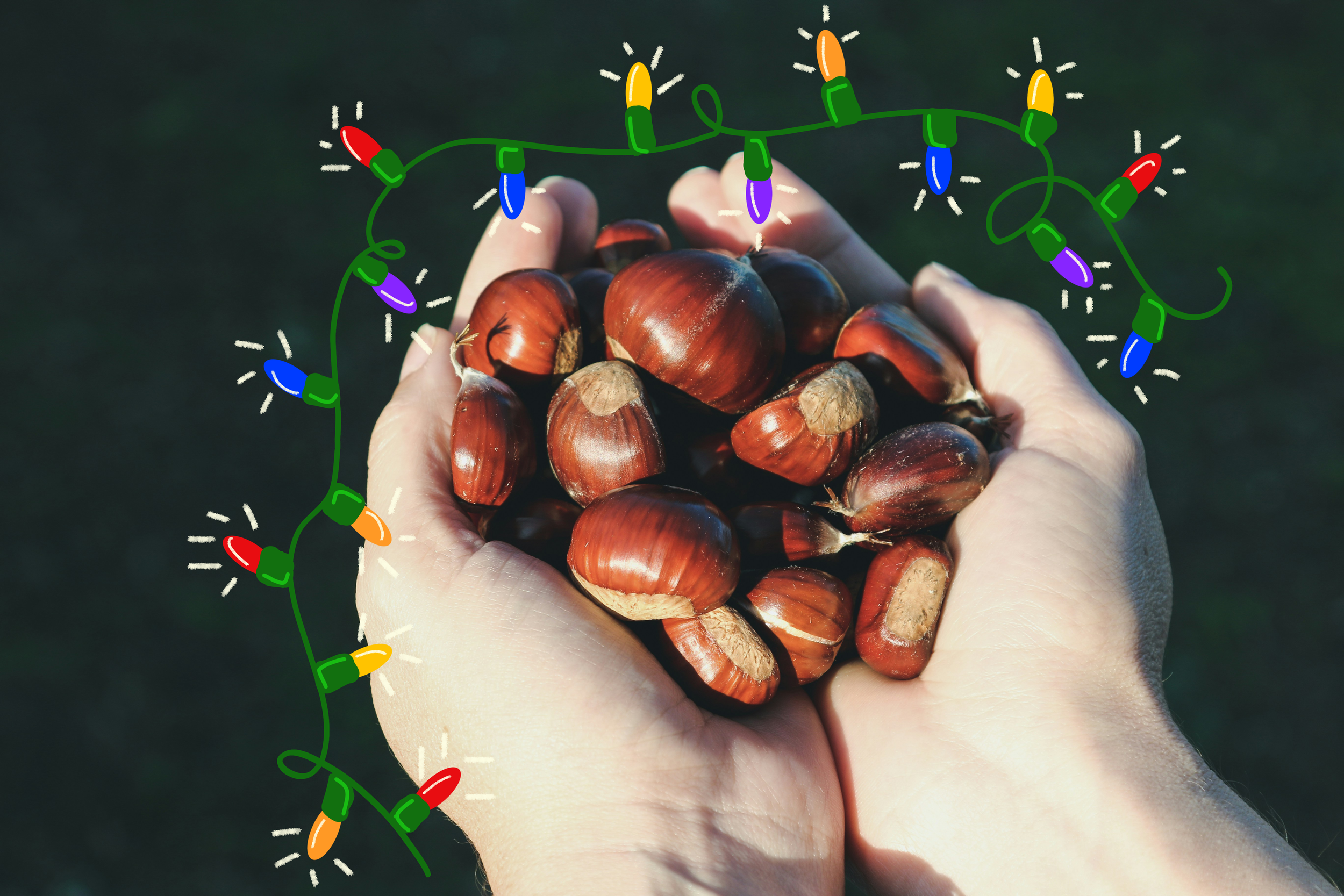
(Original Photo by Jametlene Reskp on Unsplash, illustrations by Bridget Perry)
O, Chestnut Tree

Previous
Previous
Blue Monday
Next
Next